
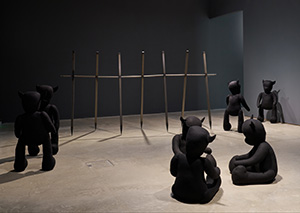
Ten Teddies & Barrier, 2017
Nothing is Fixed, JHG, Southampton
Can you really be yourself if you are constantly hiding?
Permindar Kaur in conversation with Dorothy Price
DP Hello Permindar, can we start our conversation today with your work, Brown Sloth? It’s hanging on the wall in its own space in the gallery and it meets the visitor as soon as they enter the exhibition. It seems to me that it’s a work which signals many of the concerns of your oeuvre more generally, ideas about comfort and danger, that inhabit one’s experience of looking at your work. Can you say a little more about Brown Sloth as the opening gambit for the exhibition, brilliantly titled Nothing is Fixed?
PK I decided to put this work forefront as I thought the audience would really like it – it’s playful and inviting. The sloth seems harmless atop the canvas, idling, with not a thing on its mind. The lack of stuffing makes the sloth passive – it is unmoving and limp – sharply contrasted by its large claws. I actually made this work back in 2013, I’ve just never shown it before.
DP No, I’ve never seen it; immediately it evokes a sense of empathy and I think that’s to do with the tactile nature of the fur. I notice this a lot about your work, particularly in the last room filled with dark fabric-covered teddies. Because of their small height and the freestanding nature of them (and with this one because of the fur) it seems as though there is an invitation to touch, which obviously as gallery visitors we’re not allowed to do. But along with this furry invitation to touch in Brown Sloth, there are also some fierce looking claws warning us not to get too close because it might lash out. What’s really interesting is the tension between the desire to touch and the trepidation evoked, that you manage to create across much of your work in different ways. But I think this one particularly evokes that because of the shift in your use of materials, from polar fleece to fur.
PK To get the work to balance so that you don’t know which side it lands on – is it a friend or a foe – you just don’t know, that’s quite hard. It’s quite easy to make work that’s more disturbing, or not disturbing at all, but getting it so that you don’t know, is quite tricky.
DP Yes, and I think what you achieve so beautifully in all your work is that it’s poised on the cusp, with an invitation to the viewer, but also, an implicit sense of potential danger. We’re constantly on a hovering pivot with your work, which is interesting in relation to the idea of the title of the show, Nothing is Fixed. Would you like to say a little bit more about the title; is it your title?
PK The title came from a conversation I had with Natalie Rudd about my show Outgrown (at Art House, Wakefield, 2022). I like to make work centring around ideas of change. For instance, in You & Me (1997), I attached each figure to another through snap fasteners, meaning that their positions within the work were not fixed. In Unidentified Animals (2022), I chose not to weld the joints, allowing each horse a change of position, a change of perspective. But there is also a psychological element I think, where I want things to change, I want to allow my perspective to grow. The title is interesting to me as it can be taken negatively or positively. Change can be tough. It can lead to precarity – a loss of security, a loss of self or of home. But then again, change can mean growth, in ways entirely unpredictable. I think an artist’s life is always in that state as well, it is full of precarity.
DP Yes, indeed, and it also comes back to the idea of pivoting. We talked about the tension that you managed to create in the work, where it pivots between safety and danger, and the idea that nothing is fixed, also speaks to that. The idea that an artist’s life is always about change and precarity is very resonant but I think all of life is like that too in one way or another? I mean, even if you have a concept of home, home is never there forever. Even if ‘home’ resides in other people rather than a building, say, everything and everyone is nevertheless in transition all of the time, which is why I think the title is so evocative. It invites the audience to reflect on that concept on all sorts of levels, whether it’s practical, external, material things that change or whether it’s inner psychological change. It’s a brilliant opening gambit, I think.
PK I find that it prompts people to start talking about world problems, about the politics of what’s going on in the world right now too.
DP I like the suggestiveness of it and how that speaks across your work. In the main gallery there’s a wonderful salon hang. And by a ‘salon hang’, I mean where nothing is on one fixed point at eye level, but that work covers the expanse of the wall at different heights. Would you like to speak more about your choice of a salon hang?
PK I thought it would be interesting to show the works in this way because I wanted to reference stately homes, positions of privilege and power. I like the visual of salon hangs, consisting of portraits of past generations, bold and imposing, like a vast history staring down at you. However, the ‘portraits’ in mine are largely hidden, camouflaged. The figures do not want to be seen. I wanted the viewer to come in and feel overwhelmed, trying to find their point of focus.
DP I like that. They’re trying to fit in aren’t they? They’re trying to camouflage, which is quite interesting in relation to the way in which stately homes in this country are very much embedded in the idea of an English national identity, the idea of belonging to a nation and fitting in. Yet so much recent work that’s been done, by Corinne Fowler and the National Trust in particular, absolutely explodes that view of who the country home is for, and the fact that most country houses in the UK are built off the back of the enforced labour of enslaved African people. So it’s quite a resonant topic politically, straight into the culture wars. I like the way that you’re completely turning it on its head because it’s not something that people expect of you and your work – that you would have this work in the style of a salon hang. Then you have a nod to the heraldic crest in the top corner work, Indian Boy (2013) with the antlers. And of course, there’s the connection to the way in which the Royal Academy Summer Exhibition is always hung too. What I also love about this wall is the relationships that you’re creating both between the works and within them. I was looking at this one in the middle, Flowers and Bumps (2013–23) and I was interested in the way you have set up relationships between the figures within this single work. Can you talk a little more about the relationships you’re establishing, first of all, within this work, which is central to the hang, and then the relationships that you’re setting up across the wall as well?
PK I positioned Flowers and Bumps centrally as it is one of my favourites. In this work, there are four figures, all similar, except for the markings on their body: three with bumps and one with flowers. When I was making the work, I wanted to make them similar, but different – using the same copper form for all, but choosing to place the flower pointing inwards for one. In principle, they are the same, yet we can’t help but see them in a different way.
DP Yes, it comes back to the idea that nothing is fixed, insofar as they’re all separate. They are four individual figures side by side on a dark blue ground; three with bumps, one with flowers. But you could rearrange them at any given moment. There’s no symmetry to their arrangement, but they do have a relationship with one another and if you marry up the one on the end to the second one in, they become one. It’s like they’ve been separated, but they could become one again. But then if you do that, you lose the relationship that they have to the others. So I really like the fact that it appeared you were playing with the idea of who relates to who, and what relates to what – and that that can change in this work.
PK The work does become about the relationship between them.
DP What about the work next to Flowers and Bumps – Three Swedish Sloths (2018), because the fabric seems quite different from the kind of fabric I normally associate with your work? It evokes ideas of colonial textiles – chinoiserie and 18th century French toile de jouy, for example. The peacocks, flowers, the bamboo pergola framework, the fountain and various ornamental aspects, speak to me of textiles imported during the transatlantic slave economy and exchanged for goods and people. The kind of work, that for example, The Singh Twins make a point of when they made their Slaves of Fashion series in 2018. This fabric seems to conjure both a paradise, but, like the claws on your camouflaged sloths, inherent danger; a paradise premised on pain.
PK Typically, I go for plain fabrics, as patterned fabrics bring an unintended layer to the work with the history they carry with them. Here though, I was intrigued by this history, how the peacock becomes a sign of wealth and extravagance due to its exotic nature. I liked that the clawed figures were able to hide in such an opulent fabric, to bare their claws and cling. The fabric came from Sweden. I thought this fabric was beautiful. It felt cheeky to let my sloths loose on there. There felt a paradox in that because they are collectively hiding, they in turn each become more visible.
DP The idea of hiding is interesting because it reminds me of the last room of your show in which the black teddies in the black room are arranged in formations that look like children’s games, which speaks to how children love to play hide and seek. The way I read that room is like a tableau of different types of children’s games in a playground. You have three in a circle, you have one that looks as though it’s playing doctors and nurses with a patient on the floor, and one just resting slumped against the wall. There are also teddies who are guarding the way in, which children also do; they can be very territorial. It seems like a microcosm of the way in which global politics plays out – people playing games with each other all the time, and those games can be benign, but they can also be dangerous. And there’s a tension in that: which way will these games pan out? Who will win, who will lose.
PK Compared with the canvases, the teddies are more active. They are more solid, and they are more present. They occupy the whole room, each a metre high, and in turn quite disturbing, despite their lack of claws or antlers. They do not seem huggable – they are far too stiff, and quite hard to read, seemingly devoid of any feeling.
DP I agree, and I also think that it’s the numbers of them in the space that gives them a slightly menacing air, even though they don’t have claws. They are in formations that we don’t have access to; what are they doing in these formations? What are they plotting?
PK Everyone seems to read the work differently. Some see them as taking part in naïve playground rituals, whilst others view them in a much more sinister light. I don’t know what they are plotting. I see them as shadows.
DP Yes – shadows playing in the dark. The way that you’ve grouped them is particularly unnerving because their scale is small and domestic, and they’re arranged in not easily readable groups, only known to one another, which gives them an uncanny presence.
PK When you walk amongst them, you are a giant. So maybe you do feel a little protective. But then, you are excluded, as they form these different groups with one another, and seem to communicate in ways you have no access to. You are not allowed to enter their world, and so you are distinctly separate from them.
DP They also force you as the viewer into movements that you wouldn’t normally engage in within an art exhibition; you have to bend down to meet them on their level so they are the ones with the power, which is what I like about their formation in this space. Changing topic, I wonder whether we can talk about the materials that you use; are there any materials you particularly like working with, and are there materials you haven’t yet tried and you would like to try? Can you tell us a bit more about your materials and your choice of materials.
PK I’ve been working with polar fleece for many years, as I like the way it references protection. The fabric softens the harsh meaning behind the work. However, when the work is all fabric – like with the black teddies – the work becomes its most disturbing, I think because it’s unexpected. With the black teddies, I decided to use a black woollen fabric, as it was darker and sucked in the light. I also settled on a visual language quite early on in my practice. One of the ‘rules’ was to only use two contrasting materials such as glass and terracotta, wood and steel, rubber and copper, but recently I’ve settled on a combination of fabric with steel or copper. I’m still discovering different ways of working with the two. There’s a constant exploring of how to join these two materials together.
DP When I look at this one, Patchwork (2013), it reminds me of the early Mike Kelly mattresses that he covered in a colourful camouflage material. I know he is an artist that you’ve discussed before and I can see that very clearly in these works. I was wondering which other artists you think about when making your work?
PK Well, early on, I was a sponge. I looked at and learnt from a lot of artists, like Leonora Carrington for example. I remember as a student looking at her work, finding a book about her in the library, and from that point on I was fascinated by her work – the surrealness of it, the mystery I would never quite understand. I like making my work in this way, to open the doors to interpretation in whichever way a person feels.
DP Yes, this is another aspect I was thinking about in relation to your work, the idea that there’s always an undercurrent – and it’s not an explicit, visceral, explosive thing at all – but there’s always a slight hint of potential violence in your work; the potential for danger: like the Hunting Chair (2024) for example and the flowers in Midnight (2023) which you said that some people thought were shots from exploding bullets, or the copper ‘staples’ in Sewing 3 (2023) that look like the figure is being pinned to its ground, restricting its ability to leave, and the spikiness of the claws and the antlers in other work. There’s always the potential of danger, like the beautiful brown sloth with which we began our conversation, luring us in with its gorgeous fur, but it can scratch and attack at any minute. It returns us to the tension between safety and danger that you’re consistently holding in play in your work.
PK I have always made work about protection and defence. Protection over attack. I suppose this has been a principle throughout my life – the idea that it is easier to get by if you hide yourself, if you make yourself small. If you are not seen, then you are free to be yourself, as no one is paying attention. But then there is this question – can you really be yourself if you are constantly hiding?
John Hansard Gallery, Southampton, 17 June 2024
Dorothy Price, ‘Permindar Kaur in conversation with Dorothy Price. Can you really be yourself if you are constantly hiding?’, Nothing Is Fixed exhibition catalogue, pg 55-61.
Published on the occasion of the exhibition Permindar Kaur: Nothing is Fixed, 8 June – 7 September 2024, John Hansard Gallery, University of Southampton, Southampton. Publication supported by Jhaveri Contemporary, Mumbai.
ISBN 978-1-912431-33-5