
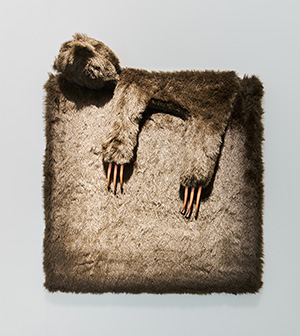
Brown Sloth, 2013
Nothing is Fixed, JHG, Southampton
All the world’s a stage
Katharine Stout
A sleepy, dark brown furry creature lies draped on top of a square panel made of the same luscious, sleek fleece, its copper claws both contrasting and complementing the texture and warm tone of the soft fabric. Presented in an antechamber of its own, Brown Sloth (2013) is the first work we encounter in Nothing is Fixed, an exhibition that takes us on a journey through bodies of work made by Permindar Kaur primarily over the last 10–12 years. These explore recurrent themes and motifs established early on in Kaur’s practice, using familiar iconography from the home and from childhood, which remain constant. Going through her sketchbooks, and making drawings again in 2010 following a ten-year break to raise her family, Kaur describes how the creatures that started to appear in her sketches ‘had claws and were more animal-like’.1 Well known for their slowness of movement, a sloth is the least threatening animal that you can encounter, with claws that provide firmness of grip allowing them to hide in camouflage high up in trees, away from predators. With the lightest undertone of threat, due to an instinct to protect their own, Brown Sloth introduces us to the way Permindar Kaur sets out to make sculptures that are both appealing and disturbing in equal measure.
The exhibition is presented as a series of rooms or stage sets in which we as the audience, or players according to William Shakespeare,2 have an active role in scribing the stories in which Kaur’s artworks are presented as characters. As we enter the first room, we are faced with an imposing wall of portraits, hung salon style, reminiscent of a Grand Hall, the most public reception space in an English stately home. Yet the figures in this series of works, made between 2012 and 2024 and assembled for the first time, do not seek attention or stare out boldly to convey their power and authority. Instead they are in camouflage, hidden in plain sight, leaving the viewer to do the work in detecting and deciphering their purpose. Like Brown Sloth, most of them have copper claws, but their passive stance belies any malicious intent. The dynamics of power and equality are played out in these clawed figures that emit a sense of precarity as they both merge and emerge from the fabric that they are made of.
Camouflage is something universally understood; as children we learn how to read and adapt to our surroundings; part of deciphering how to fit in with the dominant social codes. Different cultures have different codes and customs, reflected in how textiles (a material that Kaur has used throughout her practice) are different in various places and countries. Kaur’s early work was explicit in its reference to her own culture and upbringing as a daughter of Sikh parents who had first moved to Glasgow, then Nottingham from India, as seen in Innocence (1993) (illustrated below). This work, a child’s orange dress set against a black background and embellished by a sash that holds in place an iron knife, brings together the orange fabric associated with Sikhism, the Indian monotheistic religion that originated in the Punjab, with the kirpan, a small curved blade, one of the five K’s of the Sikh religion. The juxtaposition of the child’s dress with the knife gives the work an unsettling quality that raises questions about its title.
Kaur’s interests in foregrounding emblems of heritage and background within her early work chimed with the concerns of the British Black arts movement that was founded in 1982, inspired by the work of Stuart Hall and developed through the efforts of pioneering artists, writers and curators such as Rasheed Araeen, Sonia Boyce, Eddie Chambers and Lubaina Himid.3 This led to Kaur being invited at a relatively early stage in her career to take part in group exhibitions, such as Four X 4 at Arnolfini, Bristol (1991), the BBC Billboard Art Project in Glasgow (1992), The British Art Show 4, in Manchester, Edinburgh and Cardiff (1995) and her solo show, Cold Comfort 1 and 2, Ikon Gallery, Birmingham and Mead Gallery, Warwick (1996). Whilst these offered welcome opportunities, Kaur had concerns about becoming type-cast, and first moved to Barcelona in 1992, returning in the late 1990s, in total living there for six years. There she enjoyed the liberating context of a new culture, a new language, just as her parents had experienced when they came to the UK, and accordingly her work moved away from an immediate identification with her Indian ethnicity.
More recently her work has become more open-ended, inviting the viewer to make their own associations, or identify with the work in relation to their own cultural references, although Kaur continues to offer biographical clues, such as in India Spain Sweden (2012–13). These are countries that are all significant to Kaur – India because that is where her family is from, Spain and Sweden because she has spent significant periods of her life there, including with her young family. Kaur found it surprisingly hard to choose fabrics to represent each country – the UK is not included – with each fabric different, informing how the figure is camouflaged in all three. The Indian fabric is deliberately the most opulent, representing a country known for its extravagant ceremonies, the Spanish fabric uses an artisan technique of printing one colour onto another, whilst the Swedish fabric appears more utilitarian. Yet our interpretations are more to do with any assumptions about national identities we might bring to the work, rather than any overt comment Kaur is making. In the thirty years separating Kaur’s early works and now, the context has changed for the work and its audiences, with a tacit understanding that we are not necessarily defined by one identity, but by the intersectional features and characteristics that inform our personalities. At the same time, it seems that recently there is a tendency to foreground the ethnicity of artists, particularly those from the Global South, as an assertion, often on the part of the institution, of their presence in a reevaluated canon of art history.4
In other works, such as the triptych Untitled – 3 Figures (2013), a series of fleecy animal suits, two with antlers, are equally subject to our own interpretation, serving as empty vehicles through which we can create our own narrative.
What unites all the figures in the Camouflage series is their copper claws to repel or safeguard, and in some cases copper flowers to allure and attract. Previously Kaur’s sculptures might have once had helmets, swords and armour as protective measures, as seen in Innocence (or in Green Figure (1995–2024), included in the exhibition). The more recent language of animals and claws brings us into the world of cautionary tales for children, in which monsters offer a poignant way of working through the emotional impact of facing threats and fear at an early age. Kaur comments, ‘A lot of my work is about defence and protection so in the past I’d use swords, armour helmets and boots as a means of defence and now it’s become more integral to the figure by using claws. I also used to do lots of drawings with my son. I’d spend hours drawing monsters with him. We each drew a monster that was bigger or it had something that would make it stronger to defeat its adversary. My son gave each one of his different names, so perhaps that influenced me as well.5
Accompanying the Camouflage series is a cluster of new works exploring another central theme in Kaur’s practice, the use of domestic furniture as a way of exploring the home as a psychological space that offers shelter, but can also be an unsafe place. The home is also a constructed set for fairy tales, the apparently safe haven for characters such as Hansel and Gretel, Little Red Riding Hood or Goldilocks, representing a longing for a space to feel safe and secure. As these tales illustrate, all is not what it seems, the home, for which the bed or the chair is used as an archetypal symbol in Kaur’s work, can be a danger zone as well as a sanctuary, a place where the monsters can be hidden in plain sight, whether imagined or real. However not all monsters are foes, as seen in Maurice Sendak’s Where the Wild Things Are written in 1963, a favourite book of Kaur’s, in which the boy Max makes friends with the wild beasts of his imagination to escape the confines of his home, eventually with their help appreciating the comfort and love of his family.
Kaur has come back to a set of homely objects time and time again, such as the bed, the chair and stuffed toys, established early on in her practice. She also settled on two materials – steel and textiles – malleable for making three dimensional objects, whilst also offering complementary qualities: hard/soft; colourful/monochrome; warm/austere. These offer a means for her to create her own vocabulary that allows for endless variables and configurations, and to work with material properties and forms which Kaur feels confident in translating from her initial drawings to sculptural works, as seen in Tall Beds (1996), (illustrated below), and in Tall Chairs, a work that is presented in the exhibition, also from 1996. In these oversized works, Kaur sets out to inform the viewer’s emotional response through playing with scale. If an object is oversized it can feel threatening, or unnerving. If it is small there is a tendency to feel protective over it. Again this is reminiscent of the celebrated children’s novel, Alice’s Adventures in Wonderland, written in 1865 by Lewis Carroll and also popularised amongst other interpretations as an animated film by Disney in 1951. Alice shrinks or grows huge, according to what potion she drinks when she is ‘down the rabbit hole’, an allegory for her journey of self-discovery. Like this fantasy tale, Kaur’s works remind us of the power dynamics of childhood – when you are small you have little control over your situation, but as you get older, there is trepidation in taking on responsibilities that come with uncertainty.
For this exhibition, Kaur has created new works, such as Room 6 – Circle (2024) or Room 7 – Walking Chairs (2024): groups of miniature furniture presented as a series of individual rooms or stage sets, for the first time exhibited on plinths. As well as being works in their own right, they could be maquettes for larger sculptures or props for an animated film. The groups of chairs have an anthropomorphic quality, configured as if in motion, like a three-drawing in space. They seem to be enacting their own secret ritual or ceremony, walking in endless circles. As Kaur points out, they are reminiscent of the 1940 Disney film Fantasia, in which inanimate objects are possessed by a spell that Mickey Mouse as a Sorcerer’s Apprentice can’t undo. Kaur creates a theatrical moment in time, akin to a movie still, in which it’s up to the viewer to imagine what has happened before and what might happen next.
The notion of fear or threat within the home, specifically under the bed is explicitly played out in Untitled: Bed (2020), though play is still the operative word as the small, rotund and colourful creatures with copper spines that are congregating under the bed are at once endearing and disturbing. Within the home, the bed is one’s most private space, a shelter within a shelter, and also the location of our most intimate thoughts, and intimate fears. Deliberately left ‘Untitled’ (also to avoid the most obvious, but negative reference to ‘bed bugs’), the work is resolutely not tied to a specific meaning. However the date of the work immediately recalls bacteria, although it was actually made in 2019, just before COVID-19 asserted its disruptive presence on the world. Whilst not a direct inspiration, the stuffed sculptures are also reminiscent of emojis, the simple visualisations now omnipresent in our digital lives that can communicate emotion and action more efficiently than words. Kaur acknowledges there has always been an adherence to using the most direct means to represent something in her work, yet through juxtaposing different elements Kaur builds layers of meaning and elicits a complex emotional response from the viewer.
For the first time, Kaur is exhibiting drawings, which to date have remained as a private, preparatory way of working out ideas and practicalities before committing to a sculptural piece. Perhaps this is why the sculptural works have a very graphic quality, designed to represent the real-life object they are evoking in the most straight-forward manner. Drawing plays a dual role in Kaur’s practice; as a way to generate ideas or subjects, and as a method of meticulously planning the fabrication of a new piece or presentation of works. From a drawing, Kaur can determine every single detail of a work, and know if it’s going to work as a sculpture. Kaur explains ‘You can tell from a drawing whether it contains a complexity of ideas that will make a good sculpture that works on lots of different levels. It’s knowing how to read a drawing and then translating it into a three dimensional object.’ 6 Another artist who used both drawings and her sculptural practice to explore the domestic environment as a psychological space is Louise Bourgeois. Whether abstract or figurative, her drawings succinctly convey a lived experience, whilst also responding to external stimuli, offering a record of the emotions and events as they occurred in her life, a means to record and understand a thought or idea: ‘Drawings are thought features, they are ideas that I seize in mid-flight and put on paper. All my thoughts are visual.’ 7 When returning to making art after her career break, Kaur turned to her older sketchbooks as a way to kickstart the process of making again, reworking ideas found in earlier drawings that still had resonance. In this exhibition, the drawings reveal room plans for the installation of works, some realised, some not. It is clear to see in these compositions Kaur’s ability to understand how an object will respond to a space and transform its psyche.
Hunting Chair (2024) and Floor Flowers (2024) were made directly in response to a gallery space which has a large window facing the main civic square in Southampton, itself reminiscent of a stage set, with the Guildhall, a multi purpose events space, providing the backdrop. In this most public of the exhibition galleries, Kaur wanted to evoke the garden, whilst also creating an environment that responded to the grandeur and height of the space. The floor-based flowers made of vinyl are like a child’s drawing of a flower, designed to be viewed from a very high chair. The chair itself is modelled after the hunting chairs that are common in Sweden, found in forests where they play a seasonal, functional role, due to the need to keep the wild boar population in check. Having made Tall Chairs, they immediately reminded Kaur of her own work. To a UK audience, unfamiliar with this communal hunting furniture that is quotidian in Scandinavia and Eastern Europe, the exaggerated height of the chair is unnerving, at odds with the juxtaposition with the flowers. Antlers (2016) recreates forms actually taken from plants, yet echoes the reference to stately homes in which the mounting of a successfully hunted animal’s head signals lordship over the possessed countryside. The installation of these works together reminds us that so much of apparently natural environments are man-made and cultivated, and indeed the majority of public space is monitored and controlled.
As we move into another gallery, separate from the others, we also enter a different world in which humans are not the dominant species. Child-size, black, stuffed teddies with pointed devil’s ears are united from various works made from 2015 to 2017, and presented for the first time within a black space, creating a scene in which we are uncertain if the teddy, traditionally a close childhood companion, is friend or foe. A pointed steel barrier separates the bears, although it’s not clear if it is to keep us safe from the bears or vice versa. As inanimate confidants, a teddy’s main role is to be the recipient of our story making, often giving courage to face the unknown, as articulated by one of the best known fictional bears, Winnie the Pooh, invented by A. A. Milne to be a best friend for his son Christopher Robin: ‘I wasn’t afraid,’ said Pooh, said he, ‘I’m never afraid with you.’ 8
Another artist, Liz Magor who works with ‘stuffies’ as she calls them, (in her case found second-hand toys instead of made ones) comments that ‘When I find stuffies in the store, they’re not active. They’re lying around in heaps waiting for instructions, ready to serve our imaginary narratives, to be protagonists or players in our stories. We boss them around, using them as kind of emotional theatre pieces. We assume that we are the directors, and they are the actors.’ 9 In this scenario, Kaur positions the teddies in various configurations, absorbed in their own activities and seemingly oblivious of the viewer’s presence. The black teddies appear to have agency in this situation without the need for a human companion, they have their own agenda and narrative. Yet what this might be is still for us to decide. As with all of Kaur’s work, there is a tension in the way the artist exerts control over our emotional response to her work, through manipulating the scale and positioning of objects familiar to us since childhood. But she stops short of assigning a specific narrative or meaning, leaving this open ended – ‘Nothing is Fixed’. Whether this presents a threat or an opportunity is up to the viewer.
1 Interview between Permindar Kaur and Katharine Stout, John Hansard Gallery, 8 June 2024
2 ‘All the world’s a stage, And all the men and women merely players’; As You Like It, spoken by the melancholy Jaques in Act II Scene VII Line 139 by William Shakespeare, first published 1623
3 https://www.tate.org.uk/art/art-terms/b/british-black-arts-movement
4 Interview between Kaur and Stout, JHG, June 2024
5 Ibid.
6 Ibid.
7 Marie-Laure Bernadac, in Frances Morris (ed.) Louise Bourgeois, exh. cat. Tate Modern, London, 2008″. P. 104
8 Us Two, by A. A. Milne, first published in 1926
9 Interview between Liz Magor and Katharine Stout, 24 February 2023, on the occasion of The Rise and the Fall, an exhibition at Focal Point Gallery. https://www.fpg.org.uk/exhibition/interview-between-liz-magor-and-katharine-stout/
Katherine Stout, ‘All the World’s a Stage’, Nothing Is Fixed exhibition catalogue, pg 33- 41.
Published on the occasion of the exhibition Permindar Kaur: Nothing is Fixed, 8 June – 7 September 2024, John Hansard Gallery, University of Southampton, Southampton.