
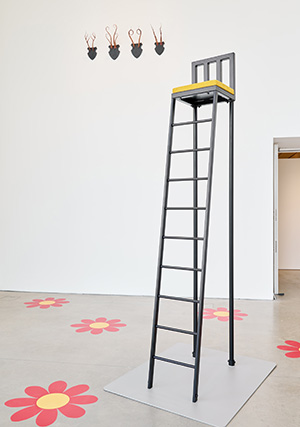
Hunting Chair, 2024
Nothing is Fixed, JHG, Southampton
Nadia Thondrayon – Introduction
Permindar Kaur’s approach to art is playful and extraordinary. She combines these tactics masterfully with the uncanny to reflect on significant cultural issues. Through her practice Kaur examines intersectionality, inquiring into how society, family and education can inform unique combinations of discrimination and privilege.
Within these explorations, Kaur connects sculpture to broader societal conversations, making her work accessible and critically relevant within today’s social and political landscape.
Kaur creates installations that unlock elements beyond what is ordinary by using everyday objects that appear displaced and distorted. Familiar forms such as beds, cots and chairs, together with brightly coloured figures reminiscent of children’s toys, may initially prompt notions of innocence and childhood but, on reflection, conjure suggestions of threat. Kaur’s use of material is deft, often combining contrasting textiles and metals to heighten their respective qualities and significance. When creating these toy-like figures, Kaur will skilfully introduce changes which subtly alter the reading of the figures, yet without closing them to interpretation.
This publication marks the occasion of Nothing is Fixed, an expansive exhibition at John Hansard Gallery that spans nearly thirty years, although it does predominantly concentrate on the past twelve years of Kaur’s artistic practice. With the exhibition as its focus, and through the contributions of Katharine Stout and Dorothy Price, this publication is an important examination of Kaur’s practice. It takes into consideration the artist’s significant contribution to contemporary art and its purpose in understanding ourselves as collective humanity.
Throughout the development of the exhibition, Kaur engaged closely with the exhibition spaces to map the work into several different ‘rooms’, with each room taking on a different sense and feel from the others. Camouflage (2012–24) is a series of canvases that cover the walls from floor to ceiling, in a style reminiscent of a stately home. Each canvas contains a figure or figures, with the background and figure crafted in the same patterned or felted fabric. Kaur playfully hides the figures within the fabric, inviting us to consider notions of representation, power and inequality. Situated in conjunction with the canvases are miniaturised furniture works that beautifully convey Kaur’s way of playing with scale to create multiple levels of questioning and unease. Additionally, Kaur creates a dream-like domestic setting through the combination of line drawings and sculptural works, including the earliest of Kaur’s work to feature in the exhibition, Green Figure (1995–2024). Within this configuration, the green figure evokes a child’s imaginary friend, or indeed an imaginary monster occupying the darkest corner of a child’s bedroom.
A new work, Hunting Chair (2024), has been especially commissioned for this exhibition. Towering within the gallery space, the work depicts an oversized hunting chair, similar to those typically found throughout forests in Scandinavia. The chair sits amongst Floor Flowers (2024); another new work of brightly coloured depictions of flowers which adorn the gallery floor to create a space that explores the domesticity of outdoor hunting. A reference also reinforced by the additional presence of the wall work, Antlers (2016). An uneasy contrast is established between interior and exterior, and we return to suggestions of stately homes and their proud display of hunting trophies.
A continuing theme throughout Kaur’s work is one of protection and defence, and a final selection of works hold an altogether different quality. Works such as Ten Teddies & Barrier (2017), Black Curtain (2016) and Armoured Truck (2016), contain teddy bear shaped figures in varying scenarios and formations, which suggest both threat and protection. The teddies are dark in colour and seem to absorb the light. Ambiguous, alluring and bewitching, Kaur often uses teddy bears in her work, not as toys but as a tool to reflect on the human condition.
Kaur’s work lends itself to the stuff of fairy tales and nightmares. Several of Kaur’s approaches align with children’s stories or nursery rhymes. Tall Chairs (1996) reminds us of ‘Humpty Dumpty’ and the play with scale in several of her works is reminiscent of ‘Alice in Wonderland’, whilst Room 7 – Walking Chairs (2024) suggests the 1940 film Fantasia. In her essay for this publication, Katharine Stout considers cautionary tales for children, such as Hansel and Gretel, Little Red Riding Hood and Goldilocks, where the idea of a warm and inviting home is threatened.
Stout also provides a detailed overview of Kaur’s work within the wider context of contemporary art-making, placing Kaur in relation to the British Black arts movement, which was founded in the early 1980s, inspired and promoted by cultural theorist Stuart Hall (and further incited by the exhibition The Other Story held at the Hayward Gallery in 1989, curated by Rasheed Araeen). Additionally, Nothing is Fixed features Kaur’s drawings for the first time. Here, Stout suggests comparisons with Louise Bourgeois who, as a sculptor, used drawing as a way to record, convey and understand her life as it occurred. Both Kaur and Bourgeois use drawing to perceive the essence of a sculptural space and to lay down ideas and motive.
Dorothy Price provides an in-depth interview with Kaur, delving into the remarkable ways in which Kaur arranges elements of her work to investigate the human psyche. Price likens the groupings of Ten Teddies & Barrier (2017) to a children’s playground, where the politics of adult life and global politics echo the behaviour and games of children. Two teddies guard the entrance to the space, much like when children have secret codes to allow entry to their makeshift dens, signifying territory and control. In another grouping one teddy stands over another, and there is an ambiguity as to whether the intention is to afflict or to help. The grouping of these creatures creates tension and Price questions which way these games will fall.
Price also describes Kaur’s work as ‘hovering on a pivot’, which lends itself entirely to the exhibition title Nothing is Fixed. For Kaur, her work focuses on change in all its guises: change in allowing one’s perspective to grow, the struggle to accept change, and the precarity that could lead to a loss of security. The very idea that ‘nothing is fixed’ applies to us all – life itself is a state of perpetual change and is the one feature that we can depend upon. Kaur’s clever and enticing work holds a mystery that can never really be grasped, always one step removed from certainty.
This pivoting between the surreal and the unknown allows Kaur’s work to be interpreted by the viewer in a way that is personal to them and as such is imaginatively accessible. Above all, however, the work begs us to ask – how do we behave towards one another, and how can we do it better?
Nadia Thondrayen, ‘Introduction’, Nothing Is Fixed exhibition catalogue, pg 17-19.
Published on the occasion of the exhibition Permindar Kaur: Nothing is Fixed, 8 June – 7 September 2024, John Hansard Gallery, University of Southampton, Southampton.
ISBN 978-1-912431-33-5