
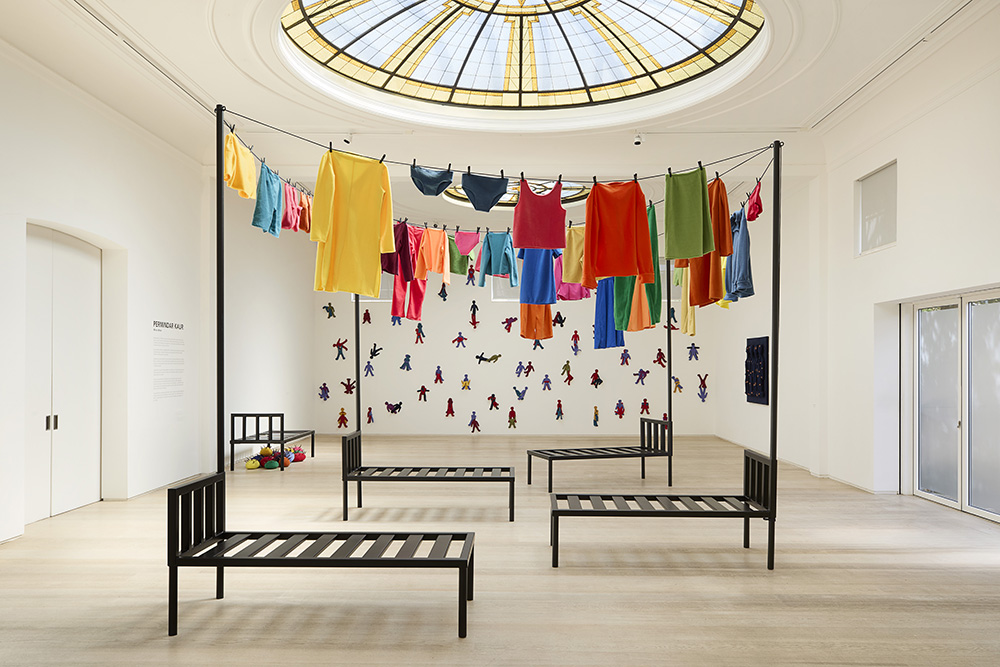
Washing Line Bed, 2025
Reflections and Doubles: Permindar Kaur and Prem Sahib at Pitzhanger Manor & Gallery
Nikhil Sardana – 07 Aug 2025 (extract)
Prem Sahib and Permindar Kaur present two compelling solo exhibitions at Pitzhanger Manor & Gallery, exploring themes of identity, visibility, vulnerability, and power through sculptural and spatial interventions that respond to the site’s layered histories.
Pitzhanger Manor & Gallery in Ealing, London, presents a dynamic double exhibition that transforms the historic home of architect Sir John Soane into a layered site of memory, subversion, and sculptural intervention. Permindar Kaur: Mirror, Mirror and Prem Sahib: Doubles foreground the complex dialogues between personal history, public space, and the architecture of identity, and are on view until 21 September 2025.
Marking the first time either artist has worked within a heritage setting, the exhibitions respond to Soane’s legacy of illusion, doubling, and narrative-rich architecture. Both artists engage the space not simply as a backdrop, but as a charged terrain to explore questions of cultural inheritance, marginalisation, and domestic power.
Permindar Kaur: Mirror, Mirror
In Mirror, Mirror, Permindar Kaur transforms Pitzhanger’s interiors into a site of dualities—childhood and control, camouflage and assertion, softness and strength. Kaur, known for her lifelong interest in power dynamics and domestic symbols, responds to the architectural specificity of the manor with striking new works as well as subtle reconfigurations of earlier pieces.
“I love working site-specific, looking at the building and its history,” Kaur explains. “I took inspiration from the curtains and the wallpaper, inspiring the artwork Baron (2025). In 2015, I made a series called Interlopers featuring black teddies taking over a gallery space. Here, I reworked it with floral print to fit the maximalist nature of the manor. It’s adapted to the space.”
Nestled in an alcove near the bust of Robert Walpole, Britain’s first Prime Minister, Baron offers a visual tension—between innocence and authority, play and politics.
In the dining room, A Life’s Journey (2025) spans six alcoves with miniature scenes inspired by the manor’s past and Kaur’s personal experiences. One contains a steel brick wall referencing Soane’s father, a bricklayer—a symbol of boundaries and silent labour:
“I have always liked the symbolism of a brick wall—an unmoving and unflinching barrier offering little in the way of rumination.”
Elsewhere, Hidden (2013) and Indian Teddies (2021–23) nestle naturally within the manor’s rooms, blending with or gently disrupting its period décor. In Three Swedish Sloths (2018), bright floral fabric conceals claws and subtle outlines—beings that seek to vanish into their surroundings:
“My work is all about power relations, the hierarchy. The manor excites me as it represents this hierarchy. Soane came from a humble background—his dad a bricklayer—and rose to success. There is an eccentric nature to the manor which my artwork responds to well.”
The exhibition continues in the gallery with Washing Line Bed (2024), where colourful fleece garments hang from steel bedframes beneath an ornate stained-glass window. A domestic gesture is rendered monumental and uncanny:
“There’s a uniformity to the clothes—shirts, knickers, socks—all made out of polar fleece. They are more a symbol of home than actual clothes. I use the harsh metal against soft fabric as a push and pull. The viewer is both invited in and made weary.”
Nearby, Threshold (2025) and Ten Teddies and Barrier (2017) deepen Kaur’s explorations of protection and marginalisation. Daggers soften into symbols, tucked into fluffy forms; teddy bears are tucked away in darkness, their presence unsettling.
“A lot of my work centres around hiding. Growing up, I had to learn how to hide who I am. It’s a hard process to learn, and an even harder one to unlearn. The camouflage is one form of exploring this… The figures want to remain hidden but can’t fully blend in. Hiding is the best form of protection.”
Kaur reflects on the evolution of her practice across decades, continents, and roles—as an artist, a mother, a diasporic thinker:
“When I first started out, my work focused on cultural identity—what it meant to be a British/Asian artist. Later, it became more internal, exploring psychological states and the domestic. Having children changed my perspective again. I returned to the art world after ten years, and now people are discovering my work as if for the first time. I’m really excited to still be showing at the level I am.”